

Author: Rebecca Caroe, Marketing Consultant
Date: July 2026
Authors Perspective
“I’ve spent twenty-five years on both sides of the RFP table, running shortlists and later delivering the work others scoped. Here is what unsettles buyers: nearly every provider now claims ‘AI-ready content’, yet few can validate a single page against the engines they target. I call it the validation gap.“
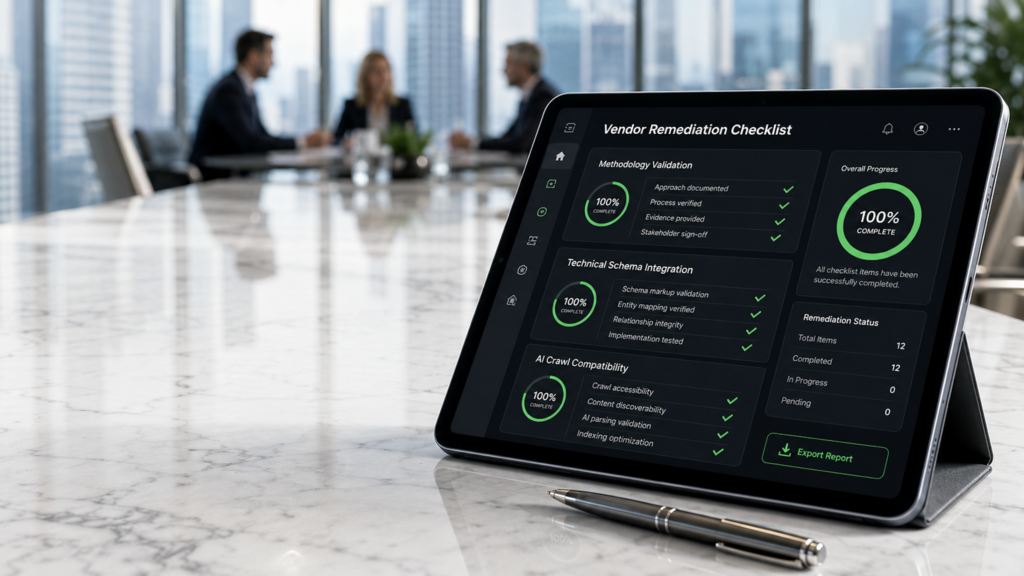
Outline
- Why procurement turns vague at this exact stage
- The three building blocks of an AI-ready page
- The twelve questions every shortlisted provider should answer
- Telling genuine methodology apart from rebranded SEO
- Validating a page against the major AI engines
- Feeding remediation outcomes back into your measurement stack
- Comparing fixed-scope, retainer and page-by-page models
- How CiteCompass approaches AEO Content Remediation
Key Takeaways
- Most providers claim “AI-ready” content; few can prove it
- Genuine remediation rests on three concrete building blocks
- Ask twelve questions across methodology, validation, integration, commercials
- Demand a before-and-after page, not a screenshot
- Validation against named AI engines separates specialists from rebranded SEO
- Outcomes must feed back into your measurement metrics
- Match the engagement model to your scope and cadence
- A vague answer is itself a useful data point
Introduction
By the time you reach this stage, the abstract question “should we invest in AI visibility” has been replaced by a much sharper one: who is going to do the work, and how do I know they are any good. The remediation specialist market is young, the vocabulary is still being settled, and almost every provider claims to deliver “AI-ready content”. Some genuinely do. Others are repackaging SEO writing under a new label. Telling the difference inside an RFP is harder than it looks.
The good news is that the underlying work has structure. Genuine AEO content remediation is built on three concrete elements: Answer Nuggets that AI engines can lift cleanly into a synthesised response, machine-readable schema that gives those answers the structural context crawlers need to interpret them, and citation source alignment that anchors your content in the third-party sources AI engines already treat as trustworthy. A serious provider can explain each of these in detail, show you remediated pages, and validate the work against the major AI crawlers. A weaker provider talks in generalities and leans on case-study screenshots that do not survive a methodology question.
This article gives you the buyer’s checklist we wish more organisations had at the contracting stage. It covers the twelve questions worth asking every shortlisted provider, how to spot the difference between methodology and marketing, and how the CiteCompass AEO Content Remediation Service approaches the work. The aim is not to pre-position CiteCompass. It is to help you ask better questions of every vendor you meet, including us.
Why Procurement Turns Vague at This Stage
This is the point where a previously rigorous process tends to go soft. The category is new, so there is no established benchmark to weigh proposals against, and “AI-ready” is easy to assert and hard to disprove inside a written response. Procurement teams that would never accept a vague answer on security or uptime will quietly wave through a content claim they cannot test. The cost of that vagueness is real: months of rework, remediated pages that still do not get cited, and a programme that loses internal credibility before it has had a chance to prove itself. The fix is the same discipline you would apply to any technology selection. Define measurable requirements before the RFP, score against weighted criteria rather than a feature checklist, and ask for evidence rather than assurances. Buyer behaviour has already shifted this way: Forrester’s State of Business Buying 2026, drawn from nearly 18,000 buyers, shows most evaluation now happens independently, on evidence the buyer gathers, before a sales conversation begins.
What Genuine Remediation Actually Does
Before you can evaluate a provider, you need a clear picture of the work itself. An AI-ready page rests on three building blocks.
Answer Nuggets. Concise, high-density passages that lead with the answer and can be extracted cleanly into a synthesised AI response. This is the opposite of burying the point three paragraphs down.
Machine-readable schema. Structured data, usually JSON-LD built on schema.org vocabulary, that tells an engine what your content means rather than only what it says. Google’s own structured data guidance is the baseline reference here.
Citation source alignment. Anchoring your claims in the credible third-party sources AI engines already trust, so your content earns citation by association.
These are not cosmetic. The peer-reviewed GEO study from Princeton and Georgia Tech (Aggarwal et al., KDD 2024) found that adding statistics, quoting named sources and citing credible references lifted visibility in generative responses by up to 40 percent, with the largest gains for pages that were previously invisible. The same research is blunt that keyword stuffing, the reflex of the old SEO world, often performs worse than doing nothing.
The Twelve Questions Worth Asking
Group your questions so you can compare providers side by side.
Methodology
- Can you show a real before-and-after remediated page, not a screenshot?
- How do you identify Answer Nugget opportunities on a given page?
- What schema types do you implement, and how do you decide?
Validation
- How do you prove a page is readable by ChatGPT, Claude, Gemini, Perplexity and Google AI Overviews?
- Will you share the validation report for every remediated page?
- What happens when a page fails validation?
Integration
- How do outcomes feed back into our AI Visibility Score, mention rate, source rate and Share of Voice?
- How will the work interact with our CMS and existing SEO setup?
- Who owns schema implementation governance with our IT team?
Commercials
- Is this fixed-scope, retainer or page-by-page, and why?
- What is the reporting cadence, and what SLAs apply?
- What does “done” mean – the explicit deliverables for each page?
A provider who answers these crisply is working at the technical layer. A provider who changes the subject is selling a rebranded service page.
Methodology Versus Marketing
The quickest way to separate a genuine specialist from an SEO agency with a new landing page is to ask them to walk you through a single page. A specialist will show the original, the remediated version, the schema they added, and the validation evidence, and they will explain why each change was made. A repackaged provider retreats into language about “quality content” and “best practice” and offers a client logo wall in place of a method. Neither polish nor confidence is evidence. A shared, testable artefact is.
Validation and Integration
Validation is where claims become checkable. The strongest providers do not assert that a page is AI-readable; they demonstrate it, both against the engines your buyers use and against independent tooling such as Google’s Rich Results Test, which confirms whether your structured data is valid and eligible. Insist on a validation report for every page, not a sample.
Integration is the partner to validation. Remediation that lives in a separate document is a missed opportunity. Outcomes should flow back into the same measurement layer you use to track the programme, so that a remediated page can be traced through to movement in your AI Visibility Score, mention rate, source rate and Share of Voice. If a provider cannot connect their work to your metrics, you are buying activity, not outcomes.
Comparing the Engagement Models
You will encounter three commercial shapes, and each suits a different situation. Fixed-scope engagements remediate a defined set of pages for a defined price, which works well when your diagnostic has already identified the pages that matter and you want predictable cost. Retainers suit organisations with continuous content velocity that need remediation embedded as an ongoing discipline rather than a one-off project. Page-by-page models offer flexibility and are useful for piloting, though the per-page cost is usually higher and momentum can be slower. None is inherently better. Match the model to your scope, your cadence and your appetite for governance overhead.
How CiteCompass Approaches AEO Content Remediation
The CiteCompass AEO Content Remediation Service is a hands-on technical engagement built on the three building blocks above plus disciplined validation. We take the “Digital Attic” content identified by the CiteCompass platform and re-architect it rather than simply rewriting it. In practice that means Answer Nugget optimisation, schema and structured-data implementation in JSON-LD, citation source alignment against the trust networks AI engines already validate, and a validation report proving each page is crawlable and interpretable by the major AI bots. The outcome is a set of AI-ready assets delivered without diverting your internal engineering or SEO resources, with results that feed back into the metrics you already track. For the underlying standards and methodology, our knowledge-hub material on technical implementation is a useful companion.
How do I get started with AEO Content Remediation Service?
Contact us today to discuss how the CiteCompass AEO Content Remediation Service will deliver real business outcomes: https://citecompass.com/contact-us/
Next Steps
Choosing the right partner is the start of the work, not the end of it. Our final piece looks at what happens after the first pages are remediated: the early signals worth tracking in the first 90 days, how to communicate the wins to your CFO and CEO, and how to turn a one-off engagement into durable citation authority. [Read part five of the series here.]
For more information, contact us
About the Author

Rebecca Caroe is a seasoned B2B marketer, founder, and digital strategist with over 20 years of experience helping professional services and technology firms grow through content, SEO, and partner-led strategies. She has advised clients across Australasia, the UK, and the US on adapting to disruptive changes in digital marketing, including the rise of AI search and zero-click discovery. As the founder of Creative Agency Secrets and a sought-after marketing mentor, Rebecca brings deep insight into how brands can stay visible, relevant, and revenue-generating in a rapidly evolving search landscape.
Connect with Rebecca on LinkedIn
How do I optimise my WebSite for AI Visibility?
- How AI Search Is Reshaping B2B Discovery
- How to Build the Business Case for AI Visibility Investment
- How to Structure an AI Visibility Programme That Delivers an ROI
- What Good AEO Content Remediation Looks Like
- How to Turn an AEO Engagement into Sustainable Citation Authority
Understanding AI Search Optimisation
- Why Your Website Traffic Is Disappearing – And Implications for Your Sales Funnel
- The Invisible Brand - How Zero Click Search Is Disrupting B2B Marketing
- Choosing a Partner for AI Search Visibility - What to Look For (And What to Avoid)
- Optimising for the Clickless Future - What Modern Visibility Really Looks Like
- From Search to Shortlist – How Zero‑Click Content Converts Without a Visit