

Author: Rebecca Caroe, Marketing Consultant
Date: July 2026
Authors Perspective
“I’ve spent twenty-five years watching what happens after the win – the moment a programme goes live and everyone assumes the work is done. Here is the surprise three months in: hard-won visibility decays quietly unless someone owns it. In order to to ensure sustainable voice of authority for your prospective customers, you need to treat citation authority is a continual improvement process, not a milestone.“
Outline
- What good progress looks like in 90 days
- The early metrics that matter, read honestly
- Communicating wins to your CFO and board
- Why remediation is an operating model, not a project
- Embedding AEO discipline into content production
- Building durable citation authority across the journey
- When to extend into Strategic AI Optimisation
- A monthly, quarterly and annual operating cadence
Key Takeaways
- Early signals appear within weeks, not days
- Read mention rate and source rate honestly
- Translate wins into finance and sales language
- Gains erode without ongoing content governance
- New content must meet the remediated standard
- Authority compounds across the whole buying journey
- Extend into Strategic AI Optimisation when foundations hold
- Sustain the programme with a fixed cadence
Introduction
The engagement is live. The first batch of pages has been remediated. Validation reports confirm that the major AI crawlers can now read, parse and lift your answer passages cleanly. Early mention-rate data is starting to move in the right direction. This is the moment most organisations either capitalise on the work or quietly let it slide back into the “Digital Attic” that prompted the engagement in the first place.
The difference between those two outcomes is rarely about the quality of the remediation itself. It is about what happens in the weeks and months afterwards. Whether the wins get communicated upward in the language the CFO and CEO recognise. Whether new content is governed against the same standard as the remediated pages. Whether the programme evolves from “fix our existing pages” to “build durable citation authority over time”. The best AI visibility programmes treat remediation as the opening move, not the closing one.
This article covers what to expect in the first 30, 60 and 90 days, how to communicate ROI to the people who funded the work, and how to build the operating model that turns one-off remediation into compounding visibility.
What Good Progress Looks Like in 90 Days
AI visibility does not move like a switch; it moves like a tide. In the first 30 days, expect validation to confirm that the major engines can now crawl and interpret your remediated pages. By 60 days, watch for the first shifts in whether your brand is mentioned and cited on the high-intent queries you remediated against. By 90 days, you are looking for a trend rather than a spike: consistent appearance in synthesised answers, not a single lucky citation. Honest expectation-setting matters here, because the temptation to over-read week-one data is the fastest way to lose internal confidence in a programme that is actually working.
The Early Metrics That Matter, Read Honestly
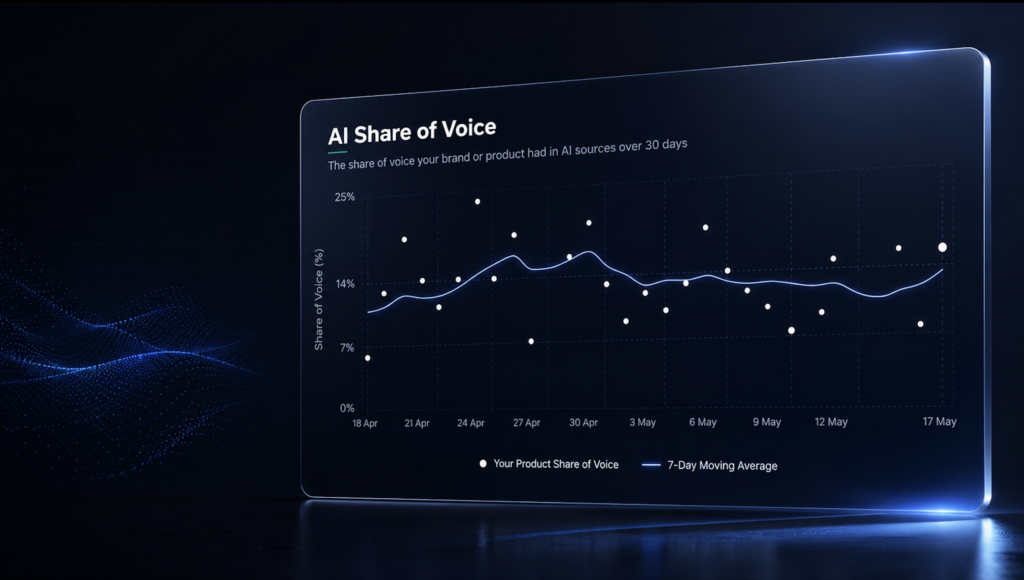
Five measures tell the real story: mention rate (how often your brand appears), source rate (how often you are cited as a source), Citation Authority (the credibility weight engines attach to those citations), Share of Voice against your competitive set, and ultimately your AI Visibility Score. Read them as a portfolio, not in isolation. A rising mention rate with a flat source rate, for example, means engines are noticing you but not yet trusting you enough to cite you – a signal to strengthen authority, not to declare victory. Our knowledge-hub explainer on Citation Authority sets out how these measures relate.
Communicating the Wins Upward
The people who approved the budget do not speak in mention rates. Translate. For the CFO, frame progress as risk reduction and pipeline protection on the queries that matter most. For the CEO, frame it as defending the brand’s presence in the place buyers now begin their research. For sales leadership, connect it to shortlist appearance and the texture of early conversations. Forrester’s State of Business Buying 2026, drawn from nearly 18,000 buyers, places generative AI as the single most-cited meaningful interaction in B2B research, which gives you a credible, externally validated reason for why this work belongs on the executive agenda.
Why Remediation Is an Operating Model, Not a Project
Here is the trap. A project has an end date; citation authority does not. Content reliably follows a predictable arc, growing, plateauing and then quietly declining unless it is maintained – a pattern the SEO industry has long called content decay. AI engines intensify this effect because they weight recency and freshness heavily, so a remediated page that is never revisited loses ground as competitors publish newer, better-structured answers. Treating remediation as a one-off fix all but guarantees that the gains erode. Treating it as an operating discipline is what makes them compound.
Embedding AEO Discipline into Content Production
The cheapest visibility you will ever earn is the visibility you do not lose. Every new page your team publishes should meet the same standard as the remediated ones: an answer-first structure, valid machine-readable schema that stays current as content changes (Google’s structured data guidance is the baseline), and claims anchored in credible sources. Bake those checks into your editorial workflow as a definition of done, not an afterthought, and new content stops sliding into the Digital Attic the moment it is published.
Building Durable Citation Authority Across the Journey
Page-level remediation wins specific answers. Durable authority wins the category. The next layer is to extend the discipline beyond your highest-intent pages to the full arc of the buying journey, so that whenever a buyer asks an AI engine a question in your space, your brand is a credible candidate to be cited. This is the slow, compounding work: the peer-reviewed GEO research from Princeton and Georgia Tech confirms that citations, credible quotations and verifiable statistics are what reliably lift visibility in generative responses, and that advantage accrues to the organisations that apply it consistently over time.
When to Extend into Strategic AI Optimisation
Once your remediated pages are holding their gains and your team has internalised the discipline, the question shifts from “fix” to “lead”. This is the point at which a Strategic AI Optimisation retainer earns its place: a forward-looking programme that monitors your position continuously, prioritises the next wave of pages, and builds the earned-media authority that page-level work alone cannot reach. The trigger is not the calendar; it is evidence that the foundations are stable enough to build on.
A Practical Operating Cadence
Sustain the programme with a rhythm rather than relying on heroics. Monthly, review your core metrics and remediate the next small batch of high-intent pages. Quarterly, audit for decay across your priority library and brief leadership on progress in their language. Annually, reassess your competitive Share of Voice, your governance standard and whether the operating model needs to expand. The cadence is what converts a one-off engagement into a capability the organisation owns.
How do I get started with AEO Content Remediation Service?
Contact us today to discuss how the CiteCompass AEO Content Remediation Service will deliver real business outcomes: https://citecompass.com/contact-us/
Next Steps
If you are early in a remediation programme and want to discuss how to structure the next phase – whether that is extending into Strategic AI Optimisation, embedding AEO governance into your content production workflow, or building the internal ROI narrative for your board – contact us today to discuss how the AEO Content Remediation Service will deliver value to your business. This is the final article in our five-part series on AI visibility and content remediation, taking you from the first signals that something has shifted through to sustaining citation authority over the long term.
For more information, contact us
About the Author

Rebecca Caroe is a seasoned B2B marketer, founder, and digital strategist with over 20 years of experience helping professional services and technology firms grow through content, SEO, and partner-led strategies. She has advised clients across Australasia, the UK, and the US on adapting to disruptive changes in digital marketing, including the rise of AI search and zero-click discovery. As the founder of Creative Agency Secrets and a sought-after marketing mentor, Rebecca brings deep insight into how brands can stay visible, relevant, and revenue-generating in a rapidly evolving search landscape.
Connect with Rebecca on LinkedIn
How do I optimise my WebSite for AI Visibility?
- How AI Search Is Reshaping B2B Discovery
- How to Build the Business Case for AI Visibility Investment
- How to Structure an AI Visibility Programme That Delivers an ROI
- What Good AEO Content Remediation Looks Like
- How to Turn an AEO Engagement into Sustainable Citation Authority
Understanding AI Search Optimisation
- Why Your Website Traffic Is Disappearing – And Implications for Your Sales Funnel
- The Invisible Brand - How Zero Click Search Is Disrupting B2B Marketing
- Choosing a Partner for AI Search Visibility - What to Look For (And What to Avoid)
- Optimising for the Clickless Future - What Modern Visibility Really Looks Like
- From Search to Shortlist – How Zero‑Click Content Converts Without a Visit