


Doug Johnstone, Digital Pivot
17 August 2026
Author Introduction
Ive spent more than 20 years working in complex B2B sales, delivery and marketing roles, I have watched the mechanics of B2B growth change significantly. However, one pattern remains remarkably consistent. When growth slows, organisations tend to look downstream for the problem. Sales needs more opportunities. Marketing needs to generate more leads. The website needs more traffic. Salespeople need more training. We need another campaign. Sometimes those things are true. But increasingly, we believe they are symptoms rather than the underlying problem.
At Digital Pivot, our work with B2B technology, consulting and professional-services organisations has led us to think about growth as an interconnected system (see graphic below).
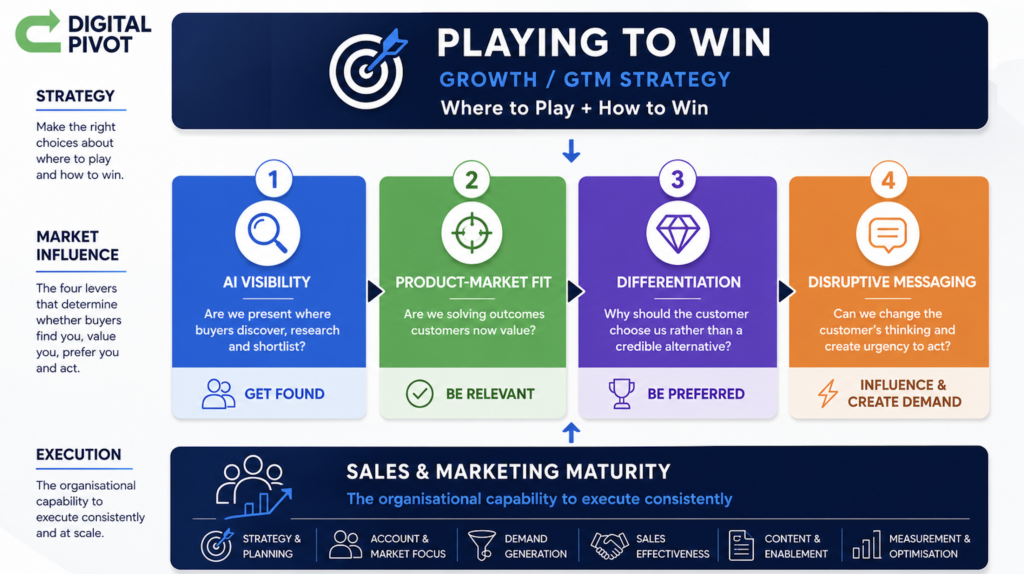
That system starts with strategy. It then requires Visibility, Product-Market Fit, Differentiation and Disruptive Messaging. And underneath everything sits the organisation’s Sales and Marketing Maturity – its ability to execute those choices consistently. If one of those elements is weak, simply increasing sales and marketing activity rarely fixes the underlying problem. It may just amplify it.
Outline
- Why more leads won’t fix slowing B2B growth
- Playing to Win: where to play, how to win
- Visibility: can the buyer find you?
- Product-Market Fit: once found, are you relevant?
- Differentiation: why should the buyer choose you?
- Disruptive Messaging: why should the customer change?
- Sales and Marketing Maturity: can you execute?
- Diagnose growth top-down, then scale demand
Key Takeaways
- Lead generation sits inside the growth system, not above it
- 94% of buyers shortlist before contacting any vendor
- Visibility now spans traditional search and AI answers
- Weak fit or differentiation amplifies, not fixes, activity
- Your biggest competitor is often “doing nothing”
- Disruptive messaging reframes the problem to create urgency
- Maturity turns strategy into a repeatable growth engine
- Diagnose top-down before scaling demand generation
Most B2B companies respond to slowing growth by trying to generate more leads. But if buyers cannot find you, your offer is not sufficiently relevant, your differentiation is weak, or your message gives customers no reason to change, more lead generation simply pushes more activity through an inefficient growth system.
The answer is not necessarily more marketing. We believe it is getting the whole B2B growth system working together.
The B2B growth problem has changed
For years, the standard response to a revenue shortfall has been predictable: “We need more leads.”
So the organisation increases advertising, creates more content, hires another salesperson, buys another prospecting tool or launches another campaign.
But consider what has to be true before a lead has any meaningful chance of becoming revenue. The prospective customer must:
- find you;
- recognise that what you offer is relevant to an important business problem;
- understand why you are meaningfully different from the alternatives;
- have sufficient reason to change from what they are doing today; and
- experience a sales and marketing process capable of converting that interest into action.
Lead generation sits inside this system. It is not the system.
And that distinction is becoming increasingly important because the B2B buying journey itself has changed.
Research from 6sense’s 2025 B2B Buyer Experience Report found that 94% of buying groups rank their shortlist before initiating contact with sellers. They then contact their preferred vendor first, and that preferred vendor wins nearly 80% of the time.
That changes the commercial question. It is no longer simply: How do we generate more leads?
It becomes: How do we influence the buyer before the shortlist is formed?
To answer that, we need to look at B2B growth as a system.
The Digital Pivot B2B Growth System
At its simplest, the model has three layers.
Strategy
Playing to Win – Where to Play and How to Win.
The four growth levers
Visibility → Product-Market Fit → Differentiation → Disruptive Messaging.
Or, expressed from the customer’s perspective:
Get Found → Be Relevant → Be Preferred → Create a Reason to Change.
Execution
Sales and Marketing Maturity.
The power of the model comes from the relationship between the components. You cannot compensate indefinitely for weakness in one area by increasing investment somewhere else.
1. Playing to Win: where will we play and how will we win?
Growth starts with choice. The Playing to Win strategy framework developed by A.G. Lafley and Roger Martin describes strategy as an integrated set of five choices: winning aspiration, where to play, how to win, the capabilities required to win, and the management systems required to support those capabilities. For B2B organisations, two questions sit at the heart of this:
Where will we play?
Which customers, markets, sectors, problems, use cases and buying situations are we going to focus on?
How will we win?
Why should those customers select us rather than an incumbent, competitor, alternative solution or simply doing nothing?
These questions sound straightforward. However, many B2B organisations have accumulated products, services, capabilities and target markets over years. Their strategy can slowly become:
“We sell everything we can do to anyone who might buy it.”
This is not a strategy.
At Digital Pivot, our Offering Pivot approach starts by testing an offer against customer relevance, market demand, differentiation, commercial performance and strategic fit. Before asking how to generate demand, first ask:
Are we playing in a market where we have a credible opportunity to win?
2. Visibility: can the buyer find you?
Once you decide where to play, you have to become visible there. Historically, B2B visibility meant a combination of brand awareness, search rankings, events, referrals, advertising, analyst coverage and sales outreach. Those channels still matter. However, another layer has emerged.
Buyers can now use ChatGPT, Gemini, Microsoft Copilot, Perplexity, Google AI results and other AI-powered discovery tools to research problems, identify potential solutions, compare approaches and discover suppliers. They can move surprisingly far through their research without visiting your website or speaking to your sales team.
This makes shortlist visibility more important than website traffic alone. The issue is explored in more detail in Digital Pivot’s AI Search and AEO Optimisation work, which focuses on whether organisations are visible and credible during AI-assisted B2B research.
The key question is no longer: “Do we rank on Google?” It is:
When our ideal customer researches this problem, are we one of the companies, approaches or sources they discover and trust?
You can have excellent product-market fit and compelling differentiation. However, if the market never discovers you, those advantages have limited commercial value.
Visibility gets you into the consideration set.
3. Product-Market Fit: once they find you, are you relevant?
Visibility without relevance simply creates exposure. Product-market fit asks a harder question.
Does a clearly defined market care enough about the problem we solve to take action?
This is particularly challenging for professional-services and technology firms because many offers begin life inside the organisation. A team has expertise. A technology vendor introduces a new capability. A consultancy develops an innovative methodology. A business sees an emerging technology trend. Someone decides:
“We should package this and take it to market.”
The danger is confusing internal capability with external demand. Strong product-market fit requires alignment between:
- a clearly defined customer;
- an important problem or opportunity;
- the outcome the customer wants;
- the urgency attached to achieving it;
- the economics of solving it; and
- the organisation’s ability to credibly deliver the result.
This is why Digital Pivot uses customer research, experimentation and rapid prototyping for new B2B offerings before committing heavily to a new proposition. The objective is not merely to create a better service description. It is to establish evidence that this customer, this problem, this outcome and this offer belong together.
Product-market fit makes you relevant.
4. Differentiation: why should the buyer choose you?
Now imagine the first three components are working. You have selected the right market. The customer can find you. They recognise that your offer solves a relevant problem. There is still another question:
Why you?
This is where many B2B propositions become indistinguishable. Look across almost any professional-services category and you will encounter remarkably similar claims:
- trusted partner;
- customer focused;
- experienced team;
- innovative solutions;
- end-to-end capability;
- tailored approach;
- industry expertise;
- great customer service.
Most of these may be true. Few constitute meaningful differentiation. Differentiation has to create preference. The buyer needs to understand something materially different about your approach, expertise, commercial model, IP, delivery method, ecosystem or ability to achieve the desired outcome.
This is closely connected to the How to Win choice in Playing to Win. If two competitors appear equally capable of solving the same problem, price, familiarity or incumbent advantage can quickly become the deciding factor. Real differentiation changes that equation. It gives the customer a defensible reason to prefer you.
Differentiation makes you preferred.
5. Disruptive Messaging: why should the customer change?
Even strong differentiation does not solve the final problem. Your greatest competitor in a complex B2B sale is often not another supplier. It is “doing nothing”.
The customer may accept that you are capable. They may understand your difference. They may even prefer your solution. However, there is still no deal unless the organisation believes there is a compelling reason to change. This is where disruptive messaging becomes critical.
Rather than beginning with “Here is why our solution is better”, the conversation begins with “There may be something important about this problem that you haven’t fully considered”.
That philosophy closely aligns with the Challenger approach to Commercial Insight. Challenger’s explanation of its methodology describes the objective as bringing a differentiated point of view to the buyer, revealing something the customer may not have fully considered, connecting it to commercial impact and creating momentum for change. That is fundamentally different from conventional product messaging.
Consider the difference.
Traditional messaging
We provide a comprehensive range of managed cybersecurity services delivered by an experienced local team.
Disruptive messaging
Your biggest cyber risk may not be having enough security tools. It may be that you have too many, creating security operational gaps between them that cyber attackers increasingly exploit while each individual platform continues to report a green dashboard.
The first describes a supplier. The second surfaces something the potential buyer has overlooked. The objective is not provocation for its own sake. It is to help the customer see their situation differently.
Disruptive messaging creates a reason to change.
6. Sales and Marketing Maturity: can you execute consistently?
This final layer underpins everything else. A good strategy executed badly is still a bad commercial outcome. Sales and Marketing Maturity is the organisation’s ability to translate strategic intent into a repeatable growth engine. That includes capabilities such as:
- market segmentation and ICP definition;
- customer buying journey understanding;
- account-based marketing;
- content and thought leadership;
- AI and search visibility;
- demand generation;
- CRM discipline;
- lead management;
- sales qualification;
- opportunity management;
- sales enablement;
- common definitions and handoffs;
- measurement and attribution; and
- regular sales and marketing operating cadences.
Recent McKinsey B2B growth research similarly describes leading B2B organisations as integrating AI, personalisation and sales accountability into a broader operating system for growth rather than treating each capability independently.
This matters because maturity creates compounding effects:
- Better targeting improves messaging relevance.
- Better content improves visibility.
- Better visibility creates better-quality engagement.
- Better qualification focuses sales resources.
- Better feedback from sales improves product-market fit.
- Better measurement tells the organisation what to improve next.
Sales and marketing stop behaving like separate departments. They become components of the same commercial system.
More activity cannot compensate for a broken growth system

This brings us back to the original problem. Revenue is behind target. Pipeline is weak. The immediate reaction is: “We need more leads.”
However, imagine pouring twice as many prospects into a system where:
- buyers cannot discover you;
- the proposition has marginal product-market fit;
- competitors appear interchangeable;
- the messaging creates no urgency;
- sales and marketing execution is inconsistent.
Twice the activity does not solve the problem. It may simply mean “twice the wasted effort”.
This is why I increasingly believe organisations should diagnose growth from the top down rather than the funnel up. Ask these questions in this order:
- Strategy – where are we playing, and how do we intend to win?
- Visibility – can the customers we want actually find us?
- Product-Market Fit – do they care enough about the problem we solve?
- Differentiation – why should they choose us?
- Disruptive Messaging – why should they change now?
- Sales and Marketing Maturity – can we execute all of this consistently?
Only then should the question become: how do we scale demand?
The B2B Growth System
The model can ultimately be summarised very simply:
Maybe you don’t have a lead-generation problem. Maybe you have a Growth System Problem. Fix that first. Then scale.
Final Thought
In an increasingly AI-shaped, buyer-controlled B2B market, growth cannot be reduced to generating more leads.
The organisations most likely to win will be those that make deliberate strategic choices, become visible before the shortlist is formed, solve problems customers genuinely value, differentiate around outcomes that matter, create a compelling reason for change and build the sales and marketing capability to execute repeatedly.
Growth is not a campaign. It is a system.
Maybe you have a Growth System Problem. Fix that first. Then scale.
If you have questions, drop me a DM – Doug Johnstone, Digital Pivot, Principal Consultant.
Frequently Asked Questions
1. What is a B2B growth system?
A B2B growth system is the combination of strategy, market visibility, product-market fit, differentiation, disruptive messaging and sales and marketing execution required to create sustainable revenue growth. Rather than treating lead generation, sales and marketing as separate activities, it considers how each element influences the others.
2. Why isn’t lead generation enough to drive B2B growth?
Lead generation creates potential opportunities, but it cannot compensate for weak product-market fit, limited visibility, poor differentiation or a lack of customer urgency. Increasing leads into a weak commercial system can increase sales and marketing cost without proportionally increasing revenue.
3. What are the six components of the Digital Pivot B2B Growth System?
The six components are Playing to Win Strategy, Visibility, Product-Market Fit, Differentiation, Disruptive Messaging, and Sales and Marketing Maturity. Playing to Win determines where the organisation competes and how it intends to win. The next four elements determine whether buyers find, value and prefer the proposition and have a reason to act. Sales and Marketing Maturity determines whether the organisation can execute the model consistently.
4. What is disruptive messaging in B2B sales?
Disruptive messaging helps a customer reconsider an existing assumption about their business problem. Instead of simply explaining why a product or service is better, it introduces insight that changes how the customer understands the problem, exposes the cost or risk of maintaining the status quo and creates a stronger reason to act.
5. How does AI search affect B2B growth?
AI search increases the importance of being discoverable during the research phase of the buying journey. Buyers can now use AI platforms to understand problems, compare approaches and identify potential suppliers before directly visiting vendor websites or engaging sales teams. B2B organisations therefore need to consider visibility across both traditional search and AI-generated answers.
6. How should a company diagnose slow B2B growth?
Start upstream. First assess where the business has chosen to compete and how it intends to win. Then evaluate visibility, product-market fit, differentiation, messaging and sales and marketing maturity. This helps determine whether the underlying issue is genuinely insufficient lead volume or a weakness elsewhere in the growth system.
References
- 6sense, 2025 B2B Buyer Experience Report.
- A.G. Lafley and Roger L. Martin, Playing to Win: How Strategy Really Works.
- Challenger, What is the Challenger Sales Methodology?.
- McKinsey and Company, The surprising economics of B2B growth.